
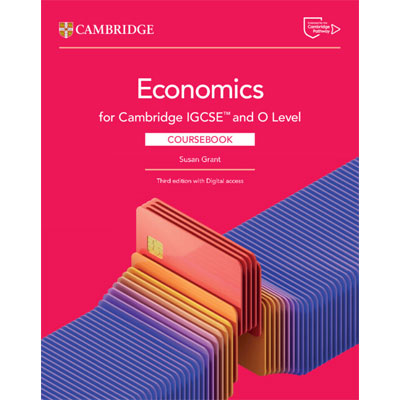
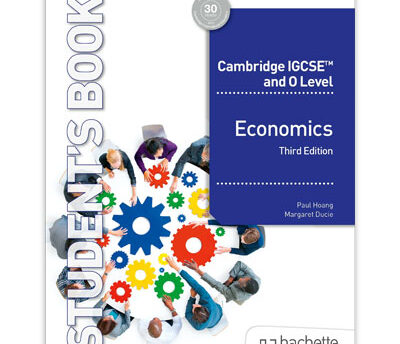
Cambridge IGCSE and O Level Economics
Pages: 514
Cambridge IGCSE and O Level Economics coursebook is one of the most popular and globally recognized programs for students who wish to understand the fundamental principles of economics. Designed with clarity, modern examples, and exam-focused content, Cambridge IGCSE and O Level Economics helps learners build a strong understanding of how individuals, businesses, and governments make economic decisions. This course is particularly useful for students who want a solid foundation in both microeconomics and macroeconomics before moving on to higher studies in business, commerce, finance, or economics.
The Cambridge IGCSE and O Level Economics syllabus covers a wide range of essential topics that explain how economies function in the real world. Students begin by exploring the basic economic problem of scarcity, choices, and opportunity cost. They learn how economic resources are allocated and how markets operate through the interaction of demand and supply. Concepts such as price determination, elasticity, and market equilibrium are presented with simple explanations and practical examples to ensure learners have a clear understanding.
As students progress, the Cambridge IGCSE and O Level Economics curriculum introduces them to different types of market structures, including perfect competition, monopoly, and oligopoly. These topics help students understand how the market environment influences prices, consumer choices, and business behavior. The syllabus also focuses on the labor market, wages, productivity, and the role of trade unions in an economy.
One of the key strengths of Cambridge IGCSE and O Level Economics is its balanced coverage of macroeconomic topics. Students learn about national income, inflation, unemployment, population, economic growth, and government policies. These areas help learners understand how economic decisions impact entire countries and global markets. The course also explains important concepts like fiscal policy, monetary policy, supply-side measures, and how governments attempt to manage the economy to achieve sustainable growth and stability.
Another major component of the Cambridge IGCSE and O Level Economics course is international trade and globalization. Learners study topics such as free trade, protectionism, exchange rates, balance of payments, and economic development. These topics are vital for understanding how countries interact economically, how global markets influence domestic prices, and why developing nations face unique challenges.
This coursebook and syllabus are highly regarded for their exam-friendly structure. Students preparing for Cambridge IGCSE and O Level Economics benefit greatly from practice questions, case studies, real-world examples, and exam-style problem-solving activities. The language is clear and accessible, making it easy for both native and non-native English speakers to understand complex economic ideas. Each chapter includes review questions, key terms, diagrams, and data-response tasks that strengthen analytical and evaluation skills.
The Cambridge IGCSE and O Level Economics syllabus not only helps students succeed academically but also builds essential life skills. Learners develop critical thinking, decision-making ability, financial awareness, and the capacity to interpret charts, graphs, and economic data. These skills are extremely valuable for future studies as well as for understanding everyday economic issues such as prices, wages, government policies, and global market trends.
Overall, Cambridge IGCSE and O Level Economics is a comprehensive and reliable guide for students who want to master the world of economics at an early stage. Its combination of theory, real-life applications, and exam-oriented content makes it one of the best choices for Cambridge learners worldwide. Whether a student aims to pursue higher studies or simply wants a strong grasp of how economies function, Cambridge IGCSE and O Level Economics provides the perfect foundation for success.
The Cambridge IGCSE and O Level Economics syllabus covers a wide range of essential topics that explain how economies function in the real world. Students begin by exploring the basic economic problem of scarcity, choices, and opportunity cost. They learn how economic resources are allocated and how markets operate through the interaction of demand and supply. Concepts such as price determination, elasticity, and market equilibrium are presented with simple explanations and practical examples to ensure learners have a clear understanding.



Reviews
There are no reviews yet.